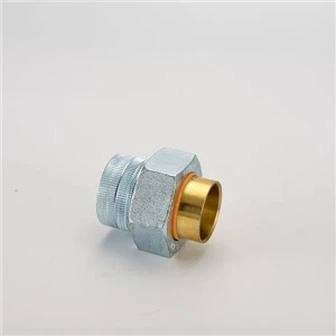
Type of lock nut
The first is to use two identical nuts to screw on the same bolt, and a tightening torque is added between the two nuts to make the bolt connection reliable.
The second type is a special locknut that needs to be used with a lockable gasket. The special locknut is not a hex nut, but a round nut with 3, 4, 6 or 8 notches on the circumference of the nut (depending on the size of the nut and the manufacturer's product range), this Several notches are the point of focus of the tightening tool and the snap-in of the lock tab.
The third type is a threaded hole (usually two, 90 in the outer circular surface) drilled through the outer surface of the nut to the inner circular thread surface, for screwing a small diameter countersunk head screw for the purpose of threading Apply a force in the centripetal direction to prevent the lock nut from loosening. A better quality lock nut sold on the market is provided with a small piece of copper on the inner circumference of the nut that is aligned with the thread of the lock nut to prevent the radial cap screw from directly contacting the locked thread and damaging the latter. . This kind of lock nut is gradually applied in the case of the shaft end locking of the rotary motion type parts, such as the anti-looseness of the ball screw mounting end bearing.
The fourth type of lock nut is composed of two parts, each part has a staggered cam. Since the internal wedge type design slope angle is larger than the nut angle of the bolt, the combination is tightly bitten into a whole, when vibration occurs. At the same time, the convex portions of the DISC-LOCK locknut are mutually displaced, and the lifting tension is generated, thereby achieving a perfect anti-loosening effect.
The fifth type is structural anti-loose, through design improvement on the thread structure, without the help of other external the factor is obtained by a self-owned locking function, so its applicability is wider than the above several methods, and the environmental requirements are also relatively low, such as the Shibong lock nut. There are many types of locknuts, such as nylon nuts, and flange nuts. In short, the locknuts are anti-loosening. Twist the nut to the screw, screw, bolt, etc., so that it will not fall off. They can be actively joined together to make them strong and stable to a high degree.